
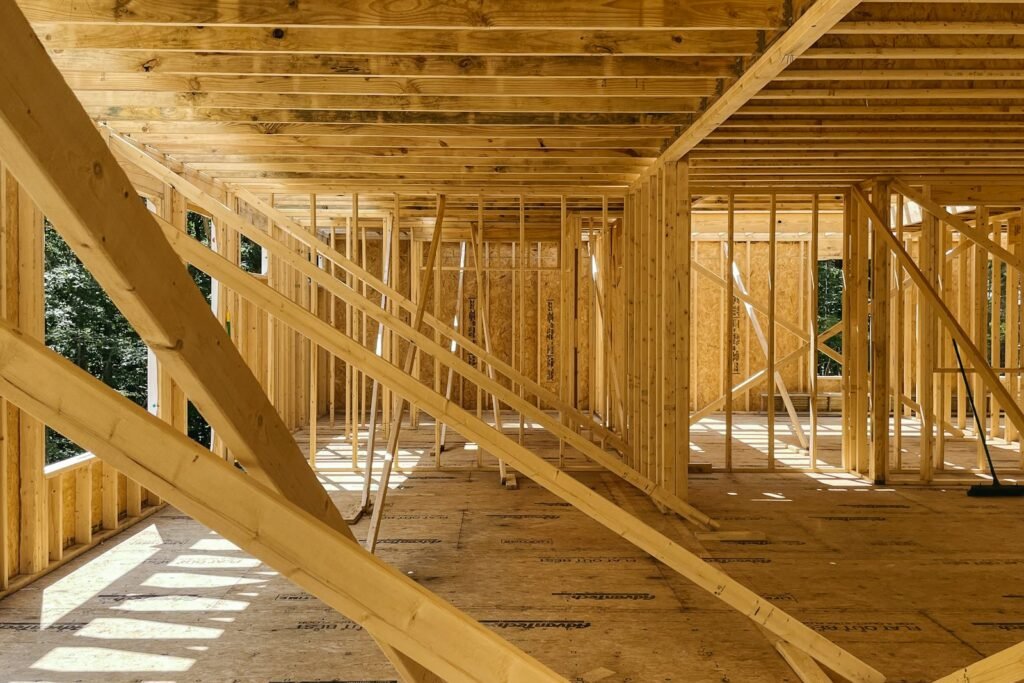
The cheapest day to wire a house for motorized shades is a day when the walls are still open. Once the drywall goes up, the same cable costs several times more to add, and some windows become impractical to reach at all. If you are building a home in Chattanooga, here is how to prewire for motorized shades, what to ask your builder, and what it costs to wait.
Why prewire for motorized shades now?
A single Cat6 cable at each window lets you use PoE shades, which get both power and control through that one cable. No batteries to charge and no outlet at the window. Read more about PoE blinds and shades.
The cable itself is inexpensive. The labor is what changes. Industry guides put a cable drop at roughly $50 to $100 during construction, compared with $150 to $300 or more once the walls are finished.
You also do not have to buy shades on day one. If the wire is in the wall, you can add motorized shades next year, or room by room. Tall great-room and stairwell windows benefit most, because those are the ones nobody wants to climb a ladder to recharge.
Where to run Cat6 at each window
- One cable per shade. A wide opening with three shades side by side needs three cables, not one.
- Exit at the top corner, on the motor side. Pick which side the motor will sit on before the cable is pulled, and keep it the same from room to room.
- Leave slack. A couple of feet coiled at the window lets the installer land the cable exactly where the bracket ends up.
- Home-run every cable. Each one goes straight back to the network panel where the PoE switch will live. No splices and no daisy chains.
- Mind the length. SmartWings supports runs up to 328 feet and recommends staying under about 260. That is rarely an issue in a house.
- Label and photograph. Label both ends of every cable, and photograph each wall before the insulation goes in.
Tell your installer whether each shade will mount inside the window frame or outside it, because that changes where the cable should come out. Remember sliding doors and covered patios too.
Plan the network panel at the same time
Every shade cable ends at a PoE switch, so the panel or closet matters. It needs a power outlet, some airflow and room for a switch and patch panel.
The same panel will feed your WiFi access points and security cameras, so this is the moment to plan all of your low voltage wiring together. Count one switch port for each shade, access point and camera. Here is what a UniFi network install includes.
What to ask your builder
- Who handles low voltage wiring, and can I bring in my own low voltage contractor?
- When is the low voltage rough-in? (It should fall after framing and electrical rough-in, and before insulation and drywall.)
- Where will the network panel go, and will it have power and airflow?
- What is the change-order price for each added cable drop?
- Can I walk the house and photograph the wiring before insulation?
- Can you add wood blocking above the wide windows so shade brackets have something solid to screw into?
For custom builders
A smart home prewire for motorized shades is a low-cost upgrade to offer at selections, and buyers notice it. Riverview IT works with Chattanooga-area builders on low voltage wiring for new construction. We schedule around your rough-in, coordinate with your superintendent and document every run. See our residential new construction services.
What does it cost to add later?
After drywall, every cable has to be fished through finished walls, around insulation and fire blocking. That means access holes, patching and paint. The same guides estimate that adding drops later costs three to five times more than doing it during construction.
| 15 shade locations | Typical range |
|---|---|
| Wired during construction | $750 to $1,500 |
| Wired after drywall | $2,250 to $4,500 or more, plus patching and paint |
[CONFIRM: swap in Riverview’s own per-drop pricing if you want local numbers here]
Some windows on two-story exterior walls cannot be reached at all without visible raceway. In those spots, battery shades become the fallback.
Prewire for motorized shades FAQ
Do I need Cat6 or Cat6A for shades?
Cat6 is plenty. SmartWings PoE motors work on Cat5e and Cat6.
Do I have to choose my shades before the prewire?
No. We only need to know which windows get a cable and which side the motor goes on.
Which windows should I prewire for shades on a tight budget?
Start with tall or hard-to-reach windows, then bedrooms and the main living area.
What if my drywall is already up?
Call us anyway. With attic or crawlspace access, we can often still get a cable to the window. Where we cannot, battery shades work well.
Mid-build? Let’s walk it before drywall
Call Riverview IT at (423) 500-0140, email help@riverviewit.com, or contact us online. We can meet you and your builder on site and mark every drop.